
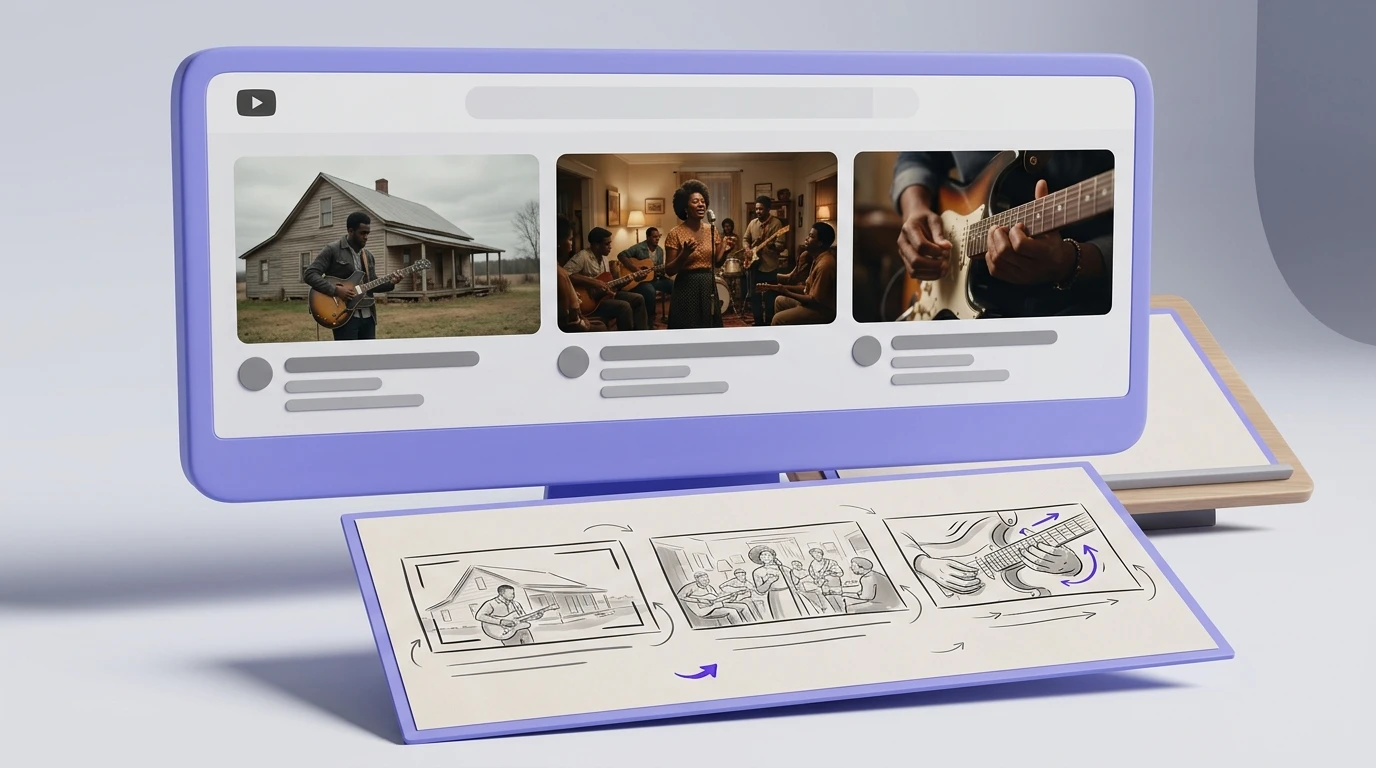
The blues music videos YouTube surfaces are worth studying for how they connect performance to place. Start with Gary Clark Jr.’s “This Land,” Alabama Shakes’ “Hold On,” and Stevie Ray Vaughan’s “Texas Flood” at the El Mocambo. These references show how to build a visual world and hold a song’s tension.
- Choose references for specific decisions. Study the setting in “This Land,” performance framing in “Hold On,” and musical phrasing in “Texas Flood.”
- Mark changes in the song before planning cuts. A vocal entrance or sustained guitar note can matter more than the next drum hit.
- Write a direction sheet that covers the entire track, including its ending. A strong opening does not solve an unfinished middle.
- Plan social crops before the final edit. Keep essential gestures readable without making every shot a close-up.
Three Blues Music Videos on YouTube to Study
These references span contemporary blues, blues-rooted soul-rock, and a filmed live performance. That range is useful: an official music video and a concert recording solve different directing problems.
Search by the artist and exact recording title. “Texas Flood” alone brings up different performances, each with its own camera coverage and edit.
| Reference | What to study | Decision to borrow |
|---|---|---|
| Gary Clark Jr., “This Land” official video | How place supports the song’s meaning | Choose a setting with a clear relationship to the lyric |
| Alabama Shakes, “Hold On” official video | How the singer and band carry the frame | Build coverage around physical performance |
| Stevie Ray Vaughan & Double Trouble, “Texas Flood,” from Live at the El Mocambo | How musical phrases sustain attention | Let an expressive passage determine shot length |
Gary Clark Jr., “This Land”: Give the location a job
Directed by Savanah Leaf, Gary Clark Jr.’s “This Land” official video places Black children and rural American surroundings alongside a song confronting racism and belonging. The setting carries meaning. It gives the lyric a physical world rather than supplying interchangeable scenery.
Study the relationship between people and the land around them. A wide frame can establish who occupies a place, while a closer view changes the emotional distance without requiring a new location.
For your own release, write down why the song belongs in its setting. A deserted roadside might support a song about leaving; a familiar room might sharpen a song about being unable to leave. If the explanation stops at “it looks cinematic,” keep developing the concept.
Borrow the relationship between lyric and location. Keep the reference’s specific imagery in its own context.
Alabama Shakes, “Hold On”: Let the performance carry the frame
In Alabama Shakes’ “Hold On” official video, the band’s shared performance space gives the viewer a clear center of attention. Brittany Howard’s delivery supplies much of the movement and emotional force.
Watch what happens inside the frame before judging the edit. A change in posture can give a shot fresh energy, especially when the camera is close enough to register effort.
This is a useful reference for a finished track that still lacks a visual concept. Start with the strongest visible action: the singer delivering the line. Add another visual element only when it gives that performance more meaning.
A modest performance setup still needs deliberate coverage. Preserve the relationship between the singer and the band instead of collecting disconnected close-ups that could belong to any song.
Stevie Ray Vaughan, “Texas Flood”: Follow the phrase
Use the Live at the El Mocambo performance to study the relationship between guitar phrasing and screen attention. A sustained note remains active because its pitch, texture, and intensity keep changing.
Follow one guitar passage through its beginning and resolution. Notice when you want to stay with Vaughan’s expression or playing, and when a wider view would help you feel the band behind him.
A cut on every beat can flatten a slow blues performance. Give an expressive phrase room to develop, then consider changing the frame when the musical thought resolves. Longer shots work best when something within them continues to change.
For a conceptual video, apply the same principle to motion. Let a figure complete a meaningful action rather than interrupting it simply because another usable shot exists.
How to Turn a Reference into a Direction Plan

A direction plan translates an observation into a choice for your own song. “Moody like this video” gives an editor little to work with; “hold the frame through the vocal phrase, then widen for the instrumental response” gives them a decision.
Our guide to music videography from treatment to final master covers the broader production sequence, but reference study can begin with a finished audio file and a plain document.
- Watch the reference uninterrupted. Identify where your attention strengthens or drifts. Write down the musical event happening at that moment before naming a camera technique.
- Watch again without sound. Check whether you understand the space and recognize the visual relationships. This separates the strength of the images from the appeal of the song.
- Map your own track by musical sections. Mark vocal entrances and instrumental passages. Include the ending, where an unresolved visual idea often becomes obvious.
- Assign a visual change to each meaningful musical change. Decide what develops and what stays consistent. Remove changes that exist only to fill time.
Filled example: A slow-blues single about leaving home
Say your finished single opens quietly, builds through a guitar solo, then returns to a restrained final vocal. A workable direction could read:
Song premise: Leaving home without feeling free of it.
Reference lesson: Use a meaningful setting, then let musical phrases control the cuts.
Visual world: A nearly empty room overlooking a road.
Recurring element: The same doorway throughout the song.
Opening and verses: Keep the subject inside the room.
Instrumental passage: Move closer to the doorway as the guitar phrase develops.
Final vocal and ending: Return to the opening composition with the doorway now open.
Continuity rule: Keep the room layout and the subject's clothing unchanged.
Social crop: Keep the subject and doorway readable in the vertical framing.
The open doorway supplies a small change with a clear purpose. It gives the ending somewhere to land without demanding another location or an unrelated visual sequence.
Use this blank version for your track:
Song premise:
Reference lesson:
Visual world:
Recurring element:
Opening and verses:
Instrumental passage:
Final vocal and ending:
Continuity rule:
Social crop:
Keep the Full Song Coherent Across Scenes and Formats
Full-song continuity means the viewer can recognize the same visual world as the music develops. A consistent subject and stable geography give you room to change the emotional pressure without making every section look like a different project.
For AI-assisted visuals, continuity needs explicit direction. Record the subject’s appearance and the location’s defining features before generating additional scenes. Check those details across adjacent shots, where changes in clothing or room layout become especially distracting.
Keep visible playing credible. If a shot clearly shows fingers performing a recognizable guitar phrase, the movement needs to match the recording. When that synchronization cannot be controlled, choose framing that does not make a false performance claim.
Format decisions belong in the plan, too. YouTube’s recommended encoding settings identify 16:9 as the standard aspect ratio for desktop playback, while explaining that the player adapts to other ratios. Review a vertical crop separately: the singer may survive the crop while the doorway that explains the scene disappears.
An approaching release date is a reason to simplify the concept. Reduce location changes before sacrificing coverage of the full track. A coherent room that develops with the song is a stronger plan than an elaborate opening followed by unrelated filler.
If you are choosing a video production company, ask how the treatment covers the instrumental passages and ending before approving it. Ask to see how essential compositions will work in the social adaptation, too.
Frequently Asked Questions
What kind of music is blues music? Blues is a musical tradition rooted in African American culture, with expressive vocal phrasing and characteristic bent or “blue” notes. Call-and-response is common, though blues can range from an unaccompanied voice to an amplified band.
Which classic blues singers are useful starting points for performance study? Bessie Smith, Muddy Waters, B.B. King, and Koko Taylor are useful starting points because their vocal delivery offers distinct lessons in emphasis and restraint. Where filmed performances are available, watch the space between lines as closely as the singing itself.
Can I use clips from these videos in my own music video? You generally need permission from the relevant rights holders unless your use falls under an applicable legal exception. YouTube’s fair use guidance explains that giving credit does not automatically make a use fair; studying a directing choice is different from reusing the footage.
Pair the sense of place in “This Land” with the performance focus of “Hold On,” then complete a direction sheet for your finished track. If that plan needs a full-song master and social-ratio adaptation, SongTrailer combines human direction with AI-assisted visuals; get in touch about your release to discuss the direction.