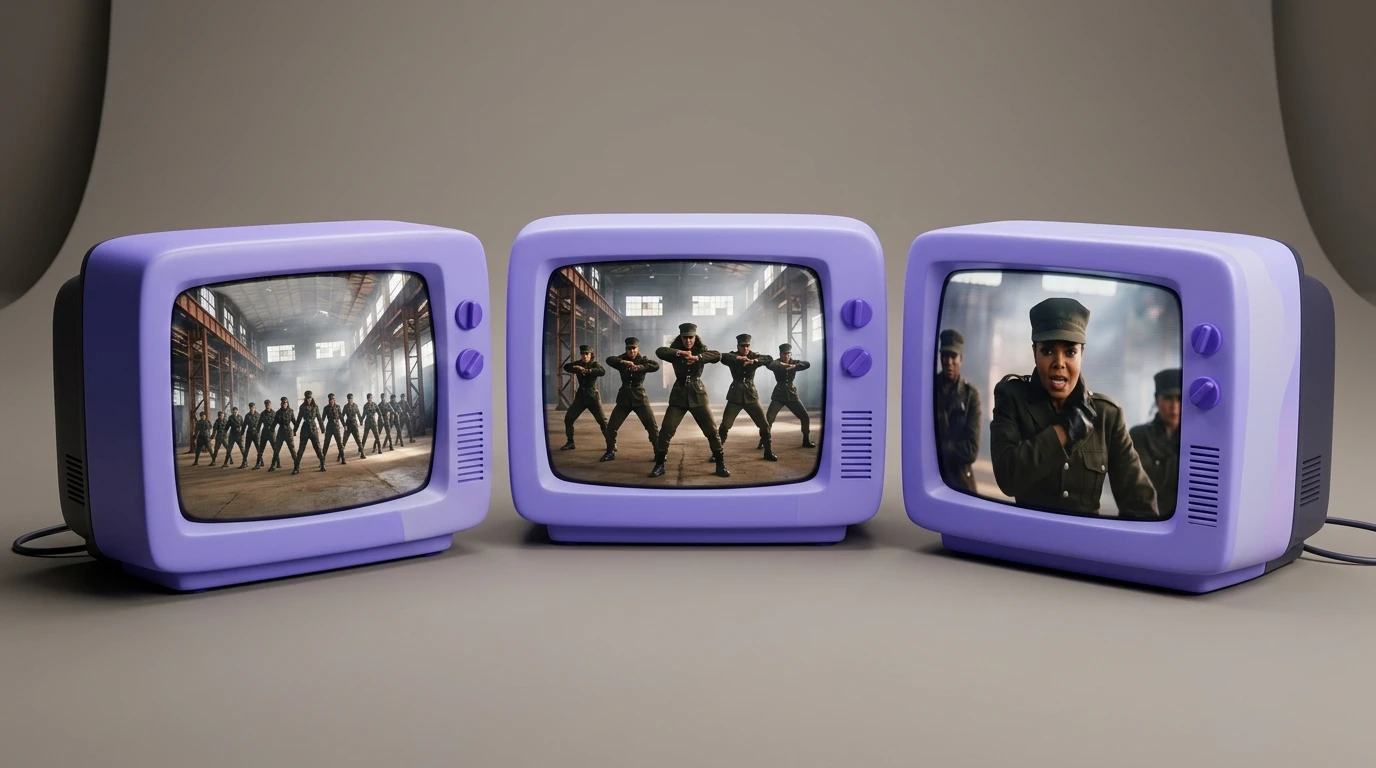
George Michael music videos move between direct performance and carefully constructed persona. In “Faith,” he makes himself the image. In “Freedom! '90,” other people carry his voice while the old image burns. Watch those together to see how presence, absence, and casting change what a song means.
- Watch “Faith” before “Freedom! '90.” The later video destroys objects associated with the earlier image, turning a change of style into part of the story.
- Separate performance from persona when watching. Singing to camera is a performance choice. Clothing, setting, and the role assigned to the singer shape the persona.
- Borrow a video's governing idea for your own brief. A restrained room or an absent singer only works when that choice supports the whole song.
George Michael Music Videos to Watch Side by Side
Start with “Faith” and “Freedom! '90,” then use the surrounding videos to test how much the artist needs to appear on screen. This is a viewing route through different creative choices, rather than a ranking of the songs.
The official George Michael video catalog includes solo work alongside Wham! material, so distinguish the group videos from the solo releases when following these changes.
| Video | What carries the song visually | What to watch for |
|---|---|---|
| “Careless Whisper” | Romantic drama and Michael's screen presence | How waterfront imagery gives private regret a glamorous setting |
| “Faith” | A sharply defined performance image | How the guitar and clothing make the singer recognizable before any story develops |
| “Father Figure” | A character-led romantic narrative | How Michael moves between being the vocalist and a figure inside the drama |
| “One More Try” | Restrained staging around the singer | How little location change the emotional performance needs |
| “Freedom! '90” | Models lip-syncing in Michael's place | How the voice remains central while the familiar star image disappears |
| “Too Funky” | Runway spectacle and backstage activity | How fashion performance takes over the frame |
| “Jesus to a Child” | Slow, symbolic imagery | How patient pacing supports grief without illustrating every lyric |
| “Fastlove” | Futuristic design and mediated desire | How screens make looking itself part of the subject |
| “Outside” | Comic role-play and disco transformation | How a public restroom becomes a space of celebration |
The useful distinction is who carries the emotion. Sometimes it is Michael's face. Sometimes it is a character, an object, or someone else's mouth moving to his voice.
How Performance Builds a Screen Persona
Performance is what the artist does on camera. Persona is the identity the video asks us to recognize. A singer can deliver a sincere vocal while appearing inside a highly controlled image.
The official “Careless Whisper” video places Michael inside a romantic drama, with waterfront settings giving the regret a polished surface. The song sounds intimate. The video makes that intimacy public and cinematic, presenting the singer as someone whose private life can sustain a screen narrative.
“Faith” makes the image more concentrated. The leather jacket, close-fitting jeans and guitar give the frame a clear center. Michael's movement does much of the work, while the setting leaves room for the viewer to study him.
The guitar works as a visual signature. It gives his hands something to do and his body a recognizable outline. The jukebox connects the performance to a broader pop vocabulary without requiring a complicated plot.
That economy belongs within the visual-world building explored in our guide to how eighties music videos built their visual worlds, but Michael makes the principle especially easy to see. The costume and performance reinforce the same identity.
“One More Try” offers a useful counterweight. Its restrained interior puts more pressure on the vocal delivery and Michael's face. Less visual activity can be a strong choice for a finished ballad, provided the performance holds attention through its changing emotional intensity.
“Father Figure” takes another route. Michael participates in a romantic narrative, so the viewer reads him both as the singer and as a character. That overlap gives the video tension: the person delivering the lyric also appears caught inside its emotional world.
Why “Freedom! '90” Works Without Michael on Screen
“Freedom! '90” replaces Michael's visible performance with other people lip-syncing his vocal. His absence becomes part of the meaning. The recording remains unmistakably his, while the video challenges the image attached to it.
Directed by David Fincher, the video features Naomi Campbell, Cindy Crawford, Linda Evangelista, Christy Turlington and Tatjana Patitz. Their presence matters beyond celebrity casting. They make the act of presenting an image visible, performing a song concerned with the distance between a person and a public identity.
The destruction gives that idea a physical form. A leather jacket burns. A jukebox explodes. Objects associated with the “Faith” image become things the video can discard.
Watch “Faith” first. Without that reference, the destruction can register as stylish spectacle. With it, the objects carry a specific history, and their removal feels like a deliberate break.
The model casting also prevents absence from becoming emptiness. Faces, gestures and changing spaces give the full track enough variation to sustain attention. Removing the singer creates a new casting problem, and the video solves it with performers who can command the frame.
“Praying for Time” offers a more stripped-back comparison through its lyric-led presentation. “Too Funky” pushes toward fashion spectacle. These approaches show that keeping the singer off screen does not prescribe a single visual style.
How “Fastlove” and “Outside” Change the Terms

“Fastlove” and “Outside” put Michael back inside highly designed worlds. His presence serves a different purpose in each. One explores desire through technology, while the other uses comedy to confront public scrutiny.
In the official “Fastlove” video, screens and futuristic seating turn attraction into something viewed through an interface. Michael occupies that system rather than simply performing against a decorative background.
The setting supplies the concept. A conventional room would change the video's meaning even if the performance stayed identical.
“Outside” makes its argument through transformation. A public restroom becomes a disco, and police imagery becomes part of the performance. The humor is direct, but the construction is precise: the setting associated with scrutiny becomes a place of pleasure.
Compare that energy with “Jesus to a Child.” Its slower symbolic imagery gives the song space to hold grief. Cinematic direction can be quiet. The useful question is whether the visual rhythm supports the emotional weight of the recording.
Turn the Contrast Into a Full-Song Brief
A useful music-video brief defines what the viewer should understand about the artist, then gives that idea a visual action that can develop across the track. References become practical when you can explain what you are borrowing.
For an independent artist with a finished breakup single and a limited location budget, I would start with the restraint of “One More Try.” Choose a room with a closed door. Give that door a role in the song.
A proposed treatment could read:
Song feeling: Afraid to leave a relationship that has already ended.
Artist role: Visible vocalist, alone in one room.
Visual rule: The door stays closed until the final chorus.
Opening: Establish the closed door before revealing the artist.
Verses: Keep the artist beside the door, avoiding the handle.
Choruses: Move closer as the vocal becomes more exposed.
Bridge: The artist finally reaches for the handle.
Final chorus: Open the door and let the light change the room.
Outro: Hold on the empty room after the artist leaves.
Continuity: Keep the room layout and wardrobe consistent.
Social adaptation: Keep the face and door readable in a vertical crop.
The changing action gives the full song somewhere to go. It also limits continuity problems, because the room's geography stays fixed while the artist's relationship to it changes.
Our guide to music videography from treatment to final master explains where this kind of direction belongs in production. Settle the central action before building individual shots, especially when a release date leaves little room for replacing an incoherent concept.
Use this shorter version for your own track:
Song feeling:
Artist role on screen:
Visual rule:
Opening image:
What changes at each chorus:
Bridge turning point:
Final image:
Details that must remain consistent:
What must survive the social crop:
Judge the brief across the full recording. An opening image may work beautifully as a teaser and still leave the later verses with nowhere to go. Each return to the chorus should deepen the same idea or change how we understand it.
Frequently Asked Questions
Are Wham!'s “Freedom” and George Michael's “Freedom! '90” the same song?
No. “Freedom” is a Wham! song, while “Freedom! '90” is a different song from Michael's solo album Listen Without Prejudice Vol. 1.
Did George Michael direct any of his own music videos?
Yes, he co-directed “Father Figure” with Andy Morahan. “Freedom! '90,” by contrast, was directed by David Fincher.
Is an official visualiser the same as the original music video?
No. A visualiser can be a separate accompaniment, including a loop rather than the original promotional film. Use George Michael's official YouTube channel to check the upload title and distinguish music videos from visualisers or audio-only releases.
Choose whether your single needs the concentrated presence of “Faith” or the deliberate distance of “Freedom! '90,” then complete the brief against the whole track. For a finished song ready for production, get in touch with SongTrailer about a human-directed, AI-assisted full-song video, with one creative director carrying the concept through the primary master and social-ratio adaptation.