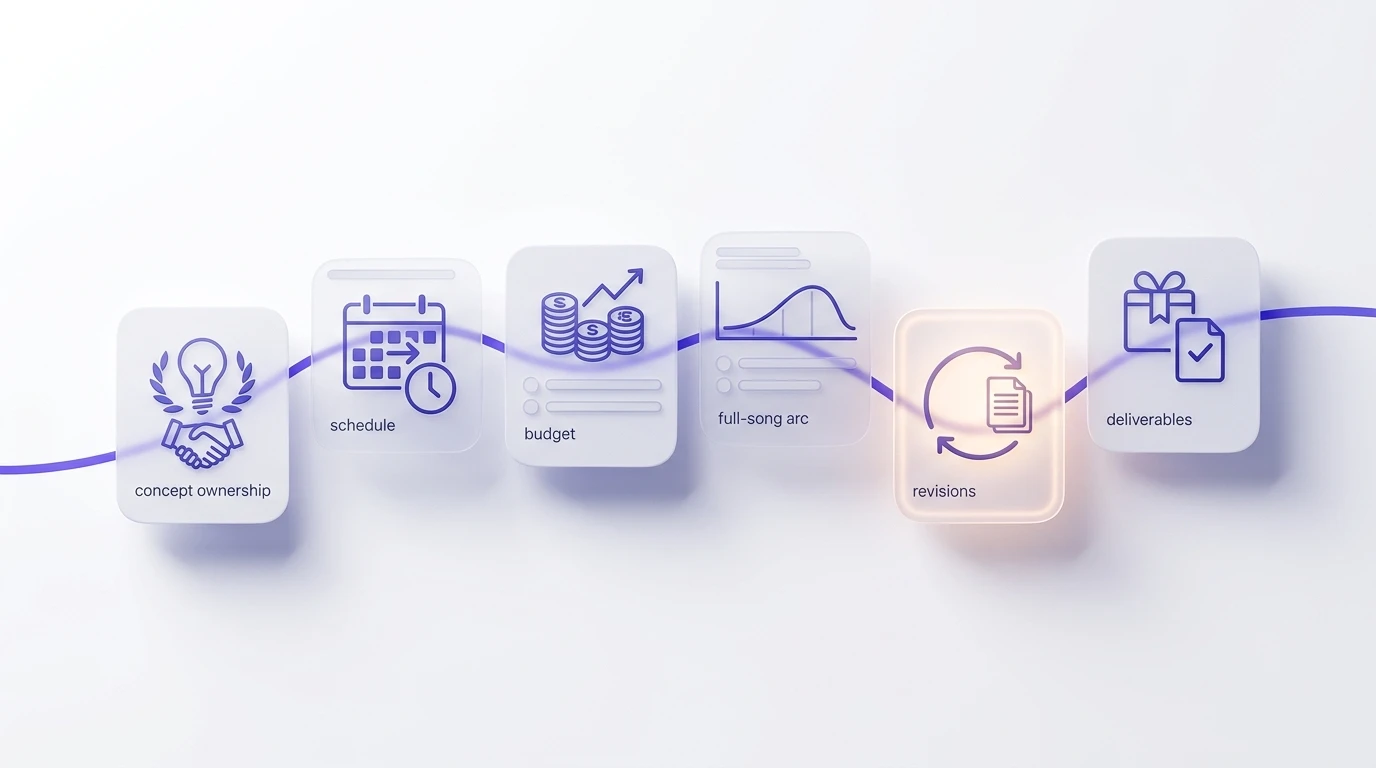
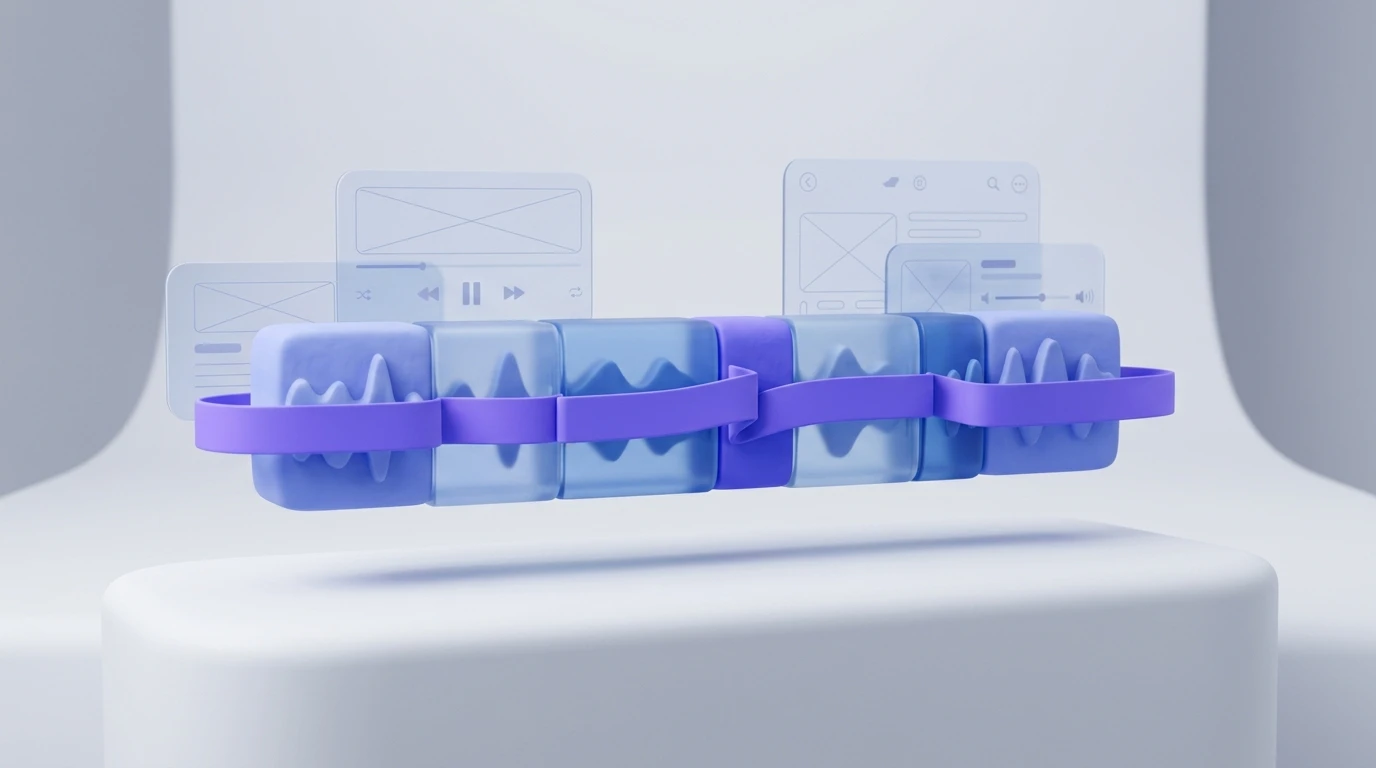
A great music video turns a finished song into one visual idea that develops with the arrangement. Map the track, lock a directorial rule set, then pace performance, narrative beats, motifs, and transitions through the full runtime. At SongTrailer, one creative director carries that line from brief through final edit. This guide shows the method.
- Map every musical section before choosing shots. The arrangement should determine where the visual world expands, contracts, repeats, or changes.
- Write one directorial rule that every frame must obey. Use it to judge locations, wardrobe, camera movement, AI-assisted imagery, and transitions.
- Test the concept across the full song and every delivery ratio. A striking chorus teaser cannot rescue weak verses or unusable vertical crops.
What makes a great music video memorable?
The great music videos of all time establish a visual rule quickly, repeat it with variation, and build toward an image the viewer can recall after the song ends. Memorable direction comes from coherence. Every creative choice appears to belong to the same world.
Consider the visual grammar of Michael Jackson's music videos. Billie Jean ties movement to illuminated surfaces, controlled framing, and a restricted nighttime world. The Smooth Criminal music video uses a period setting, coordinated costumes, choreography, and architectural lines to make the performance feel inseparable from the environment. Neither depends on constant novelty.
A strong concept can be stated in one sentence. For example: "The artist moves through a hotel where each room reflects a different version of the same failed relationship." That sentence gives the director boundaries. It can shape production design, casting, lighting, camera placement, transitions, and the ending.
A weak concept usually describes a category rather than a film: "cinematic shots of the artist in several locations." It offers no governing idea and gives the editor little material for visual progression.
Use the finished track to make the first creative decisions:
| Song signal | Directorial question | Possible decision |
|---|---|---|
| Sparse introduction | How much should the viewer understand immediately? | Begin with a partial face, isolated prop, or unfinished action |
| Verse | Where does performance feel most intimate? | Hold longer shots and reduce camera movement |
| Pre-chorus | How should tension become visible? | Tighten framing, introduce motion, or repeat a motif faster |
| Chorus | What is the video's hero image? | Reveal the main set, strongest performance setup, or central transformation |
| Bridge | What can break the established pattern? | Change perspective, time, color, or narrative control |
| Outro | Which image should remain after playback? | Resolve the opening action or leave one deliberate visual question |
The song supplies the structure. Direction gives that structure a visible form.
How do you turn a finished song into a clear treatment?
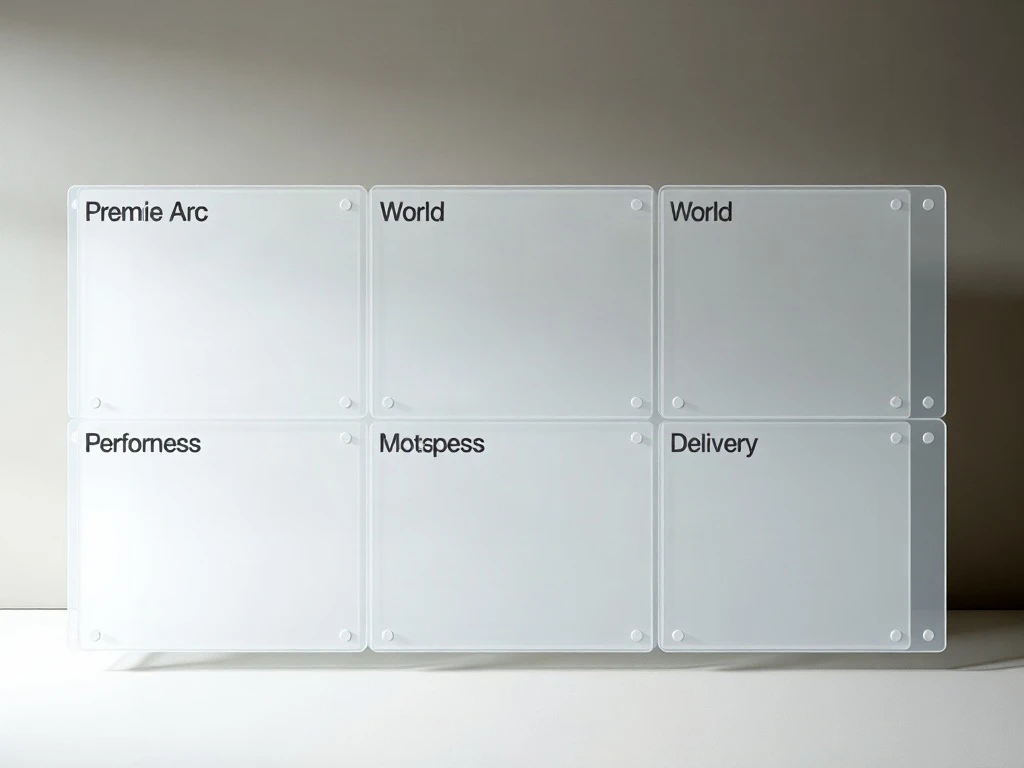
A treatment translates sound into production decisions. It should explain the central idea, emotional movement, visual rules, performance style, narrative beats, and ending clearly enough that a cinematographer, editor, stylist, or visual artist can make aligned choices.
Start with a song map. Mark the intro, verses, choruses, instrumental passages, bridge, outro, lyrical turns, rhythmic drops, and meaningful silences. Add notes for energy, vocal delivery, instrumentation, and repeated phrases. Timecodes help during production, but the creative observation matters more than the label.
Build the treatment from that map:
| Treatment element | What it must settle |
|---|---|
| Creative premise | The single visual idea carrying the entire track |
| Emotional arc | What changes between the opening and final frame |
| Visual world | Location, production design, texture, palette, wardrobe, and light |
| Performance language | Direct address, observed performance, choreography, acting, or a mixture |
| Narrative logic | Character goals, turning points, and cause-and-effect relationships |
| Recurring motifs | Objects, gestures, colors, framing patterns, or environmental changes |
| Editorial approach | Shot duration, repetition, transitions, and synchronization |
| Delivery plan | Primary master, social crops, text-safe areas, and release deadline |
A storyboard should solve blocking, composition, and transitions before production begins. It does not need polished illustration. The practical purpose of a storyboard is to reveal missing coverage and impossible spatial relationships, a point reinforced by Vimeo's guide to planning video storyboards.
Choose a small set of hero images after the treatment is stable. Each should represent a major state of the video, such as its opening mystery, chorus reveal, bridge disruption, or final resolution. These frames become visual anchors for the wider shot plan.
The full workflow from concept to delivery is covered in music videography from treatment to final master. The critical handoff is direction lock. Once the premise, palette, performance mode, and ending are approved, production can refine the idea without quietly replacing it.
How should music and video production share one rhythm?
Music and video production should follow the song's changes in energy without cutting mechanically on every beat. Editorial rhythm comes from shot duration, movement, framing, performance intensity, and visual repetition working together.
Give each section a job. A verse may establish character or space. The pre-chorus can increase pressure. The chorus should deliver the concept at full strength. The bridge earns contrast because the audience already understands the prevailing pattern.
Performance direction needs equal precision. Avoid asking an artist to "give more energy." Give playable instructions: hold eye contact through the line, delay the turn until the snare, cross the room without acknowledging the lens, or deliver the final phrase directly to camera. Specific actions produce editable differences between takes.
Narrative scenes need visible cause and effect. If a character leaves a room, the next scene should reflect that decision rather than simply offer another attractive setup. Short films can tolerate ambiguity. Randomness is harder to defend, especially when continuity breaks between wardrobe, props, lighting, and screen direction.
Visual motifs connect performance and story. A mirror introduced during the first verse might return cracked during the bridge. A red practical light can begin as background color, move onto the artist during the chorus, then disappear from the final scene. Repetition creates recognition. Variation creates progression.
Cinematography and production design should be planned together. A carefully chosen palette collapses when the location contains competing colors, while an elaborate set loses force if the lens, lighting, and blocking hide its defining geometry. Test wardrobe against the actual background and light source before committing to the setup.
Where should AI-assisted imagery fit?
AI-assisted imagery works best when the director has already defined the world. A model can generate environments, transformations, textures, inserts, and transitional material, but it needs strict references for character appearance, wardrobe, color, lens character, lighting direction, and spatial logic.
Build a continuity sheet before generation. Record the artist's defining features, approved clothing, recurring props, location rules, palette, camera height, framing tendencies, and prohibited elements. Keep approved reference frames beside every new scene. This reduces visual drift and gives refinement rounds a concrete target.
The AI music video process for artists keeps concept, pacing, and final editorial judgment under human direction. That distinction matters. A collection of impressive generated clips still fails when eyelines change randomly, hands interact differently with the same prop, or a location rebuilds itself between cuts.
Transitions deserve special attention. Generate the outgoing frame and incoming frame around a shared shape, movement, color field, or screen position. The editor then has a visual bridge rather than two disconnected clips joined by an effect.
Use AI where it expands the concept. Keep live or tightly controlled performance material where identity, lip synchronization, and emotional detail carry the song.
Which mistakes keep a great music video from working in the final edit?
A great music video can unravel in the edit when production has captured attractive moments without enough connective material. The editor then spends time hiding gaps rather than shaping rhythm.
The most expensive problems are usually visible in the first assembly:
| Editing problem | What it looks like | Practical correction |
|---|---|---|
| Coverage gap | A scene cannot move from wide action to emotional detail | Capture entrances, exits, reactions, inserts, and neutral cutaways |
| Chorus fatigue | Every chorus repeats the same framing and intensity | Reserve alternate angles, movement, or visual escalation |
| Continuity drift | Props, wardrobe, lighting, or eyelines change without purpose | Maintain a continuity record and review it between setups |
| Beat chasing | Nearly every cut lands on a musical accent | Mix synchronized cuts with phrases that run across the beat |
| Transition dependence | Effects are used to connect unrelated scenes | Design shared motion, composition, or color during pre-production |
| Front-loaded concept | The strongest material appears early, then the video stalls | Save a reveal, reversal, or new visual state for the bridge and ending |
| Social crop failure | Faces, gestures, or narrative information sit outside the crop | Compose priority action near adaptable frame zones |
Human editing controls emphasis. A cut placed before a lyric can create anticipation. The same cut after the lyric can feel reflective. Holding through an expected beat creates tension, while interrupting a movement can make the next shot feel aggressive.
Watch the first assembly without sound. The character's actions and visual progression should remain understandable. Then listen without watching. Mark where the arrangement asks for expansion, restraint, interruption, or release. The final pass joins those readings.
Refinement rounds should address decisions in order. Fix structure before individual shots, shot selection before effects, and continuity before cosmetic polish. Color grading cannot repair a missing narrative beat.
Why a video production studio must plan every master early
A video production studio should plan delivery formats during treatment and framing, not after the primary edit is approved. Horizontal and vertical versions place attention in different parts of the frame. A wide two-person composition may become unusable when cropped around one centered subject.
Design the primary master first, then treat social versions as deliberate adaptations. Reframe shots individually. Move titles. Replace wide compositions when a crop removes essential action. Some moments need alternate edits because their original pacing depends on information spread across the frame.
YouTube's official encoding guidance uses 16:9 as the standard display aspect ratio for desktop playback, while TikTok's official creative specifications prioritize 9:16 vertical delivery for full-screen placements. These are different compositions, not interchangeable export presets.
Release deadlines also change creative choices. Work backward from delivery, leaving room for direction lock, production or generation, first assembly, structural revisions, finishing, quality control, and final exports. A late concept change affects every dependent step.
When evaluating collaborators, ask who owns the treatment, who protects continuity, how revisions are handled, which masters are included, and when direction becomes locked. How to choose a video production company provides a practical framework for comparing those responsibilities rather than judging a reel alone.
Frequently Asked Questions
What is the difference between music videography and video production?
Videography usually refers to capturing footage, often with a smaller crew and a narrower production scope. Video production covers concept development, treatment, pre-production, filming or image creation, editing, sound synchronization, finishing, and master delivery.
What is the visualization of music called?
It may be called music visualization, audiovisualization, a music visualizer, or a music video. A visualizer usually uses animation or repeated graphic systems, while a music video develops performance, narrative, or a broader cinematic concept.
What is the best music visualizer?
The best visualizer supports the song's identity and survives repetition without becoming distracting. Choose a system with controlled motion, readable focal points, a defined palette, and enough variation to reflect changes in the arrangement.
What are the ten best music videos of all time?
Any ranked list is subjective, but useful references include Billie Jean, Smooth Criminal, Thriller, Sledgehammer, Take On Me, and Formation. Study each for a specific directing lesson, such as choreography, production design, compositing, visual motifs, or narrative economy, rather than copying its surface style.
A finished track already contains the pacing plan. Your job is to turn its structure into a visual rule, protect that rule through production, and refine it through every master. If you need one creative director to carry a full-song concept from brief through final edit, get in touch with SongTrailer.