
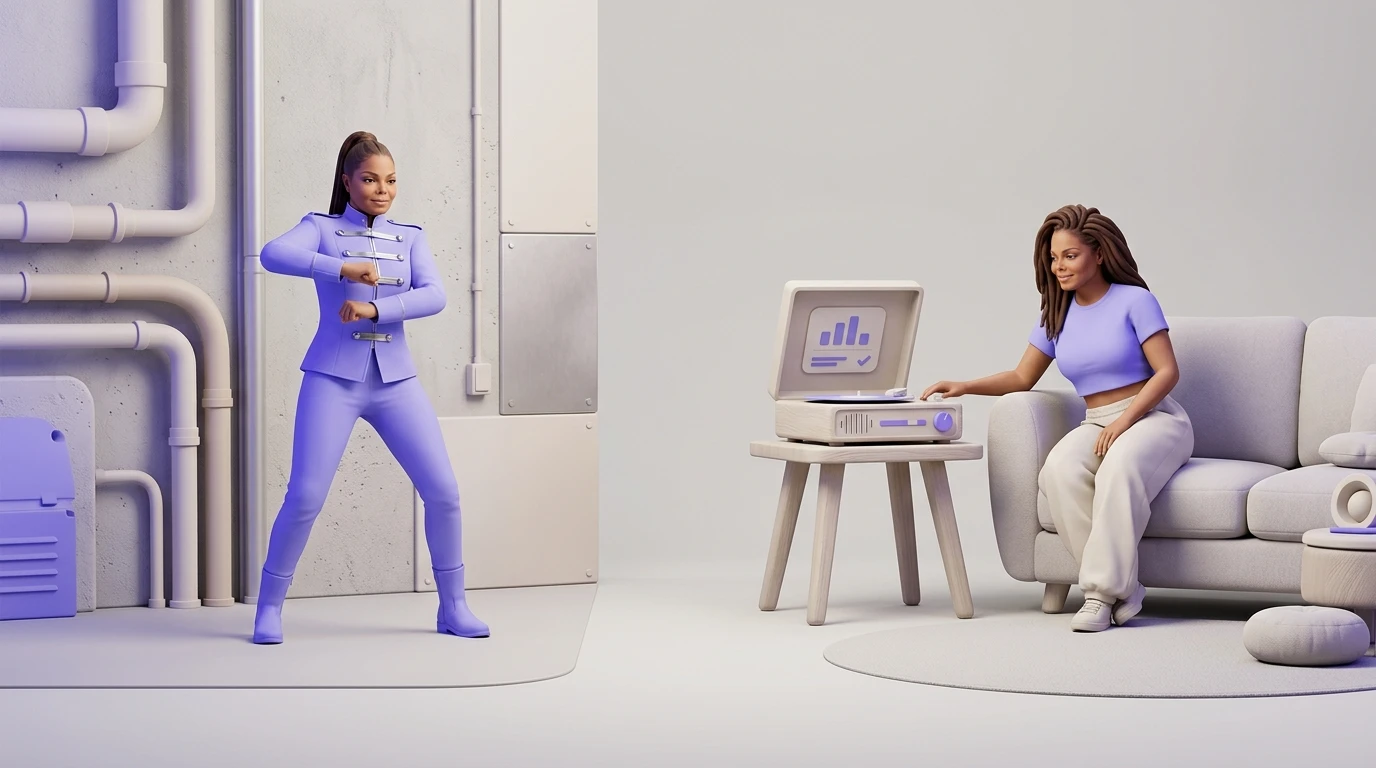
The clearest way to study janet jackson music videos is by album era: Control establishes independence; Rhythm Nation turns ensemble choreography into a visual identity; later work expands intimacy and character. IMVDb’s Janet Jackson video credits identify Dominic Sena as the director of “Rhythm Nation.” Compare the official versions to see how each visual approach serves the song.
- Separate album release dates from video release dates. “Love Will Never Do (Without You)” belongs to the *Rhythm Nation 1814* era, but its video arrived later than the album.
- Compare camera movement and editing alongside choreography. A dance sequence changes meaning when the frame shows the whole formation rather than isolated performers.
- Identify the version before studying it. A full-song video, an alternate dance edit, and a television excerpt can present the same material differently.
- Borrow a production principle rather than a recognizable costume or set. Sustained movement, consistent lighting, or a clear visual motif can strengthen an original concept.
Which criteria define Janet Jackson’s major visual eras?
An album era is a group of releases connected by musical direction and a public image. Janet Jackson’s eras are especially useful to study because their videos share recognizable choices while still allowing individual songs to have different visual worlds.
Start with the artist’s role inside the frame. In Control, Jackson asserts herself through confrontations and performance. In Rhythm Nation, she leads a disciplined collective. The janet. era allows more relaxed intimacy alongside elaborate dance spectacle.
Then examine the production language. Industrial architecture gives “Rhythm Nation” a different physical weight from the casual gathering in “That’s the Way Love Goes.” Costumes matter because they shape movement and silhouette, not simply because they look memorable.
Director credits reveal another layer. Dominic Sena connects several major performance videos; Mary Lambert helps establish the Control era; Herb Ritts brings a photographic treatment to “Love Will Never Do (Without You).” Those collaborations show how a consistent artist identity can survive a substantial change in visual style.
An era is a framework, not a uniform look. The contrast between videos within an album campaign often tells you more than their similarities.
How do Control, Rhythm Nation, janet., and later periods compare?
Jackson’s catalog moves between tightly organized spectacle and close, personal performance. Neither approach replaces the other permanently. Later videos return to ensemble choreography while changing its setting, camera language, and emotional temperature.
The representative chronology below uses original video release years and director credits documented in IMVDb’s catalog. These are video dates, not album dates or later upload dates.
| Album era or release period | Representative official videos and release years | Directors | Main visual shift |
|---|---|---|---|
| Control | “Nasty” (1986); “When I Think of You” (1986); “The Pleasure Principle” (1987) | Mary Lambert; Julien Temple; Dominic Sena, respectively | Independence expressed through character, mobile staging, and demanding solo performance |
| Rhythm Nation 1814 | “Rhythm Nation” (1989); “Love Will Never Do (Without You)” (1990) | Dominic Sena; Herb Ritts, respectively | Industrial ensemble discipline contrasted with open-air, black-and-white portraiture |
| janet. | “That’s the Way Love Goes” (1993); “If” (1993) | René Elizondo Jr.; Dominic Sena, respectively | Conversational intimacy sits beside a highly designed nightclub performance world |
| The Velvet Rope | “Got ’Til It’s Gone” (1997); “Together Again” (1997) | Mark Romanek; Seb Janiak, respectively | Period character detail and communal spaces contrast with expansive fantasy imagery |
| All for You through Discipline | “All for You” (2001); “All Nite (Don’t Stop)” (2004); “Rock with U” (2008) | Dave Meyers; Francis Lawrence; Saam Farahmand, respectively | Stylized pop environments give way to darker dance spaces and fluid camera movement |
| Unbreakable and subsequent standalone releases | “No Sleeep” (2015); “Made for Now” (2018) | Dave Meyers | Low-light domestic intimacy contrasts with a colorful, street-based ensemble celebration |
“Love Will Never Do (Without You)” is an instructive date distinction. Its album association can make it appear earlier in casual timelines. Keep the video’s release year attached to the video itself.
The later rows also resist a simple “bigger production equals progress” reading. “No Sleeep” uses restrained atmosphere. “Made for Now” opens the frame to a communal performance. Both extend ideas already present in Jackson’s earlier pop and R&B visuals.
Which Janet Jackson music videos best demonstrate the innovations?
I would begin with videos that make different production choices visible. Watching several clips with nearly identical staging teaches less than comparing a solo performance against an ensemble, then comparing both with an intimate character piece.
Choreography: “The Pleasure Principle,” “Rhythm Nation,” and “If”
“The Pleasure Principle” makes a solo performer carry the frame. The warehouse setting leaves room for physical effort to register, while changes in shot size keep the performance from becoming a static dance recording. It contains multiple shots; calling it a single-take video misdescribes the work.
The official “Rhythm Nation” music video makes formation central to the image. Wide framing lets synchronized movement read as a collective shape, while closer views sharpen individual accents. The industrial setting and uniform-inspired styling reinforce the song’s call for solidarity.
“If” places intricate choreography inside a more elaborate club concept. Screens and watching spectators make observation part of the visual world. Compare the main video with the official all-dance version to see how removing narrative material changes the balance between concept and performance.
Study the duration of a movement phrase before studying the number of cuts. Editing on every beat can interrupt the very choreography the video needs viewers to understand.
Camera continuity: “When I Think of You” and “Rock with U”
Julien Temple’s “When I Think of You” creates flow through a stylized street environment, with performers handing attention from one part of the frame to another. Concealed transitions support the impression of continuous movement. The camera participates in the choreography.
“Rock with U” offers a useful later comparison through its mobile camera and connected club spaces. Watch how bodies enter and leave the frame while Jackson remains the visual anchor. Apparent continuity depends on rehearsed staging as much as it depends on editing.
For an artist studying long takes, the practical question is whether the camera move reveals something new. A sustained shot earns its length when movement changes the composition or redirects attention.
Image and fashion: “Love Will Never Do (Without You)” and “Got ’Til It’s Gone”
Herb Ritts gives “Love Will Never Do (Without You)” a photographic clarity built around skin, fabric, and strong silhouettes. Its black-and-white imagery feels open and warm, very different from the enclosed industrial world of “Rhythm Nation.” Monochrome does not carry a fixed emotional meaning.
“Got ’Til It’s Gone” places Jackson within a South African club world shaped by apartheid-era imagery. Clothing and background characters establish a social environment rather than functioning as isolated fashion displays. The video rewards attention to the people around the lead artist.
These are distinct approaches to image direction. One concentrates attention through simplified surroundings. The other gives the lead performer meaning through a densely characterized community.
Intimacy: “That’s the Way Love Goes” and “No Sleeep”
“That’s the Way Love Goes” lets friends listening to a song become the concept. Small gestures and relaxed interaction match the track’s R&B phrasing. The performance does not need a separate dramatic plot to sustain interest.
“No Sleeep” offers another study in atmosphere, using a domestic setting and subdued light. For a quieter song, facial presence and the pace of camera changes can do more useful work than a succession of spectacular locations.
How do you identify official videos and alternate versions?
An official catalog contains different kinds of material. Official status and video type are separate questions. Concert footage can be officially released, while a polished-looking fan edit remains unofficial.
Start with Janet Jackson’s official YouTube channel and follow its links to associated releases. Check the credited artist and the version label before treating an upload as the primary video.
| Material type | How to classify it | What it can teach you |
|---|---|---|
| Lead-artist music video | Jackson is the primary credited artist; guests may appear | The main visual treatment for that release |
| Jointly billed collaboration | Both artists share the release identity, as with “Scream” | Collaboration and shared image direction |
| Guest-feature video | Another artist leads the release, as with Busta Rhymes’ “What’s It Gonna Be?!” | Jackson’s contribution within another artist’s concept |
| Alternate or extended edit | The title or description identifies a different version | How emphasis, duration, or choreography changes |
| Official concert-based video | Performance footage supplies the main visual material, as in “Black Cat” | Live presence and performance editing |
| Broadcast excerpt or unofficial upload | The upload may contain an introduction, shortened footage, or an unverified edit | Broadcast presentation, but not necessarily the complete original work |
The upload timestamp tells you when that file reached the platform. It does not establish the original premiere date. Likewise, a remastered upload can improve presentation without representing a newly produced video.
Broadcast context matters. A television segment may trim an introduction or interrupt the ending, while the Rhythm Nation 1814 film places song sequences within a longer narrative framework. Identify whether you are watching a standalone music video or material from that larger film.
For full-song analysis, use the complete official version and note any alternate edit separately. A teaser cannot show how the visual idea survives the later verses or earns its final image.
What production lessons remain useful today?
The strongest lesson is to make the song’s structure visible. A finished track needs a visual idea that can develop across its full duration, with enough consistency to feel authored.
At SongTrailer, one creative director owns concept through final edit for our human-directed, AI-assisted full-song videos. That model puts responsibility for continuity in one place. The same principle is useful when studying Jackson’s director collaborations.
Use this sequence to turn a reference into a workable brief:
- Choose one reference and identify its function. Write down what it does for the song: exposes physical performance, creates intimacy, or establishes a social setting. A useful observation names a visible choice.
- Map that function onto the finished track. Mark where the vocal enters and where the arrangement changes. Assign visual developments to those moments so the full-song master has somewhere to go.
- Write a treatment with continuity rules. Specify the recurring setting and the performer’s visual identity. The workflow in Music Videography: From Treatment to Final Master helps connect those decisions to production and editing, before isolated shots begin pulling the concept apart.
- Test the planned framing in the delivery ratios. Check whether a tighter social crop removes dancers, gestures, or essential environmental details. Adapt the composition when necessary instead of assuming the primary master can simply be cropped.
For AI-assisted visuals, continuity needs deliberate control. Keep the character design and environmental logic stable unless the treatment calls for a change. A beautiful individual shot can still damage a sequence if the costume or room changes without reason.
A short release timeline also makes scope decisions urgent. Our guide to choosing a video production company is useful when comparing responsibility and deliverables; ask who owns the final edit, what refinement is included, and which formats will be delivered before committing the budget.
Borrowing Janet’s exact industrial uniforms would produce a recognizable imitation. Borrowing the relationship between coordinated movement and readable wide framing gives you a principle that can support an original visual world.
Frequently Asked Questions
Did Michael Jackson make music with Janet Jackson? Yes. They recorded “Scream” together, and its jointly billed video was released in 1995, directed by Mark Romanek, according to IMVDb’s Michael Jackson video credits. Classify it as a collaboration rather than a solo Janet release.
Was Jennifer Lopez in a Janet Jackson video? Yes. Jennifer Lopez appears in “That’s the Way Love Goes” as part of the group hanging out with Jackson. Her appearance belongs to the video’s relaxed social setting.
Which songs from Control have official music videos? The album’s video releases include “What Have You Done for Me Lately,” “Nasty,” “When I Think of You,” “Control,” “Let’s Wait Awhile,” and “The Pleasure Principle.” They range from character-based staging to concentrated dance performance.
Is “The Pleasure Principle” a single-take video? No. It uses multiple shots and edits, even though its solo performance and consistent setting create a strong sense of continuity. Study how the framing supports movement rather than treating the clip as an uninterrupted take.
Choose one video and write a precise observation about how its images serve the song. Turn that observation into an original treatment. If you have a finished track ready for a full-song visual, get in touch with SongTrailer with your reference and the production principle you want to carry forward.