
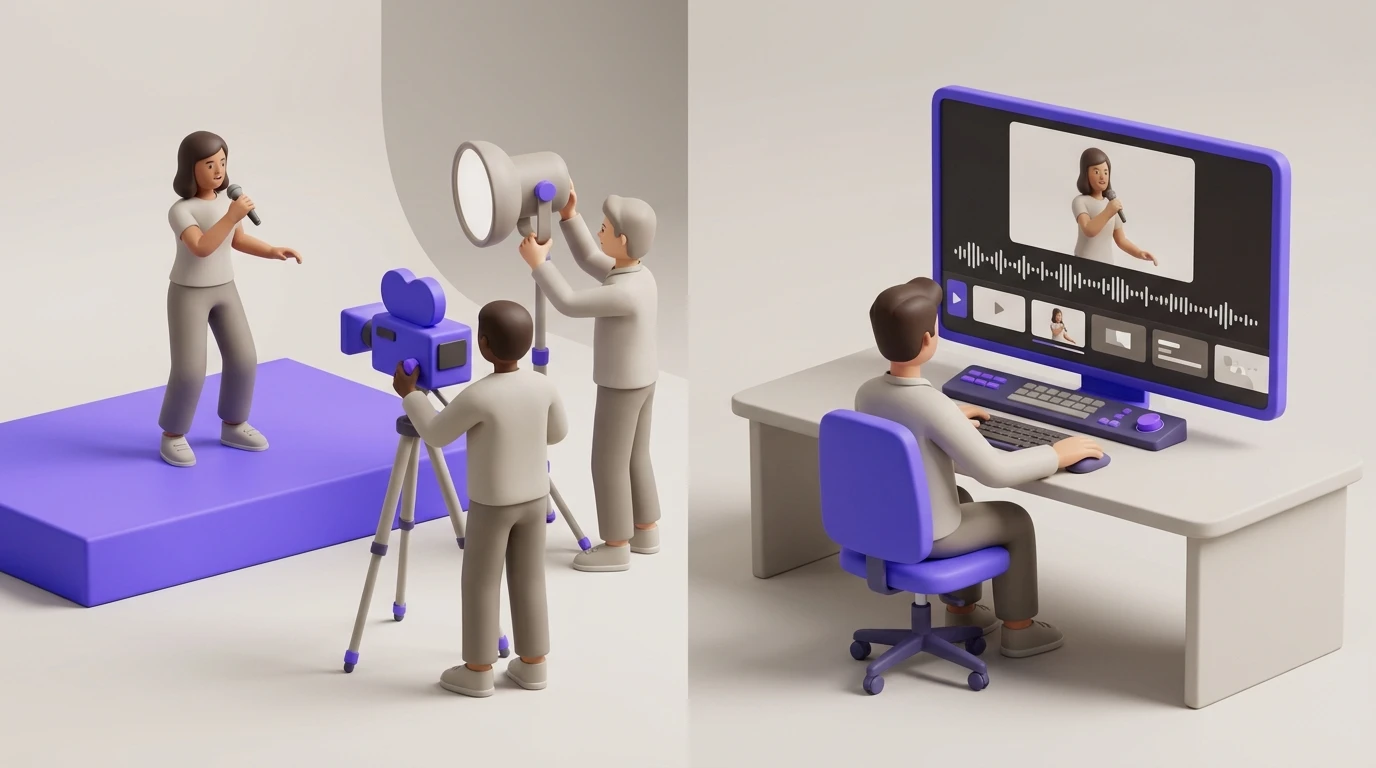
Choose video production agencies for shoots that need coordinated crews. Choose a solo creative director for a focused release, provided their scope includes the finished edit. A full-song master and a social adaptation are separate deliverables. Compare who owns direction, what the fee covers, and what starts the production clock.
- Hire against the production need. A crew-heavy performance shoot and an AI-assisted full-song video need different resources.
- Ask who owns the edit after concept approval. A director’s involvement does not automatically include production or final delivery.
- Compare complete quotes that specify the master, social adaptation, revision limits, and delivery conditions.
What should you compare before hiring?
The right partner can deliver your specific video within an agreed scope. Start with the finished result, then assess the resources needed to make it.
For an artist releasing a finished single, we would compare creative accountability first. Name the person responsible for turning the treatment, a written description of the proposed video, into the final edit. An agency can assign one accountable director. A solo director can bring in collaborators. The business label tells you little about who makes the final creative decisions.
Next, check production requirements. A performance video with cast and location access needs practical coordination. A visual world built around a finished track needs strong pacing and continuity, but may not need a physical shoot.
Finally, establish delivery accountability. Who handles revisions? Who checks the export? Our guide to choosing a video production company helps structure that assessment before you compare proposals.
How do video production agencies compare with solo directors?
Agencies offer coordinated production capacity. Solo creative directors offer direct access to the person shaping the work, though their production and editing responsibilities vary.
Use Strong, Check, and Weak as starting fit scores. These assess the production model or stated service, not the quality of an individual supplier. Fill the empty column from your candidate’s written proposal.
| Selection criterion | Video production agency | Solo creative director | SongTrailer, our service | Your candidate |
|---|---|---|---|---|
| Coordinating a substantial live shoot | Strong | Check crew and producer support | Weak for a shoot-led brief | |
| One named creative lead | Check staffing | Strong | Strong | |
| Finished-track, AI-assisted full-song video | Check capability | Check capability | Strong | |
| Full-song master plus social adaptation included | Check scope | Check scope | Strong | |
| Defined fee and production window | Check proposal | Check proposal | Strong after intake and direction lock |
Choose an agency for production scale
An agency is the stronger starting point when the concept depends on coordinating a substantial shoot. Ask who handles scheduling and what happens if a location or crew member becomes unavailable.
Skip the agency route if the proposed production structure adds work your concept does not need. A studio day and an extensive crew should serve the treatment, not become the default simply because those resources are available.
Choose a solo director for a focused creative relationship
A solo creative director suits an artist who wants direct discussion about mood and pacing. Confirm whether that person also produces and edits, or whether those roles need separate contracts.
Skip a direction-only engagement when you need a finished video from one supplier. A strong treatment still leaves production work to fund and manage if nobody owns its execution.
Where our directed full-song package fits
SongTrailer is our service for finished tracks that need a human-directed, AI-assisted video. One creative director owns the concept through the final edit, with human editing shaping the finished piece.
Our AI music video service for artists costs $3,500 flat per package, including a full-song master and social-ratio adaptation, with delivery in about 5-7 business days after intake and direction lock. Choose it for that defined release scope. Choose a shoot-led supplier when the concept depends on filming a live performance or physical location.
What should the quote and timeline include?
A useful quote defines the finished assets and the conditions for delivering them. A flat fee provides cost certainty only when the boundaries are clear.
Request a written deliverable schedule alongside the price. Full-song coverage should mean the complete track, while a social adaptation needs its own framing decisions. A subject composed at the edge of a wide frame may disappear in a vertical crop.
| Quote item | What needs to be written down |
|---|---|
| Primary master | Full track coverage, aspect ratio, resolution, file format, and approved audio version |
| Social adaptation | Required ratio, duration, reframing, and any text treatment |
| Refinement | Included review rounds, feedback deadlines, and what counts as a new direction |
| Production window | Start trigger, approval milestones, and final delivery date |
| Additional costs | Changes or expenses that require approval before work proceeds |
| Handoff and rights | Delivered files, project-file inclusion, usage rights, and third-party restrictions |
Separate production time from approval time. If the schedule begins after direction lock, an unresolved concept keeps the clock from starting. Work backward from the release date and leave room for your own review and upload checks.
Export settings also belong in the brief. YouTube lists MP4 in its recommended upload encoding settings, so ask the supplier to define the actual master specification rather than promising a vague platform-ready file.
File delivery and copyright ownership are separate questions. The U.S. Copyright Office’s work-made-for-hire guidance explains that commissioned work qualifies only under specific conditions, so put the intended rights arrangement in the agreement.
For AI-assisted visuals, avoid promises that every generated element carries exclusive copyright protection. The Copyright Office’s guidance on copyright and artificial intelligence explains the relevance of human authorship. Ask the supplier to distinguish your rights to use the delivered video from any claim about copyright in its individual elements.
How do you test the fit and send a usable brief?
Judge a production partner on a complete, relevant video and a written response to your brief. A highlight reel can show striking shots without demonstrating whether the supplier can sustain a visual idea across a song.
- Watch a complete comparable project. Check what happens after the opening. Look for pacing changes at the bridge and whether recurring characters or locations remain visually consistent.
- Send the same brief to each finalist. Ask the proposed lead to explain how the concept develops across the track and which requirements create extra work.
- Approve the treatment and scope before locking the schedule. Resolve who gives feedback and what happens when an approved direction changes.
For a finished single built around a night-drive concept, ask how the visual world survives beyond the opening road shot. A useful answer might develop one recurring location through changes in light, then return to it at the final chorus. That demonstrates a plan for continuity.
The music videography workflow from treatment to final master explains how those creative decisions become production and editing tasks. Use the brief below to give each candidate the same starting point.
Track title and duration:
Release date:
Required final delivery date:
Audience and release goal:
Visual concept and reference links:
Artist likeness or filmed performance required:
Existing footage and its rights status:
Full-song master requirements:
Social adaptation requirements:
Budget ceiling:
Person authorised to approve direction:
Expected feedback turnaround:
Required review rounds:
Required file handoff and usage rights:
A clear response should identify assumptions and exclusions. If a supplier promises the date before reviewing the track or understanding the concept, ask what that commitment depends on.
Frequently Asked Questions
What is the difference between videography and video production?
Videography usually centres on capturing footage. Video production covers the wider process, including planning and post-production, although suppliers use these labels differently.
Is a creative director the same as a video producer?
A creative director shapes the concept and visual decisions. A producer manages the resources and logistics needed to deliver them, though one person may hold both roles on a smaller project.
Should I hire a local video production company?
Choose a local video production firm when venue access or an in-person shoot makes proximity useful. Remote direction can suit work built from supplied audio or footage, provided the review process and file delivery are explicit.
For the finished-single brief above, choose the partner whose written scope covers the entire song and the adaptation you need for release. If human-directed, AI-assisted production fits that brief, get in touch with our team about the track and release date. Bring the same deliverable requirements you would ask any agency or solo director to meet.