A search for video production company boston should lead to a shortlist built around relevant full-song work and a complete delivery scope. SongTrailer includes a full-song master and social-ratio adaptation in its package. Use the criteria below to compare local filming with human-directed, AI-assisted production against your release budget and deadline.
- Request complete music videos by the director assigned to your project. A highlight reel cannot prove full-song pacing.
- Compare the total delivery price. Crew rates and equipment rental tell you little when editing remains unquoted.
- Make the schedule start point explicit. A turnaround measured after direction approval does not include the time spent preparing your brief.
- Put social formats, refinement limits, and file rights in writing before booking.
Which criteria separate a strong video production company Boston artists can use?
A strong music-video partner can explain how the finished track becomes a coherent film, then commit to a defined delivery scope. Local availability matters when you need a shoot. Musical judgment matters in every production model.
Start with complete songs. Watch how the director handles a repeated chorus, a quiet bridge, and the ending. A beautiful opening proves little if the remaining track repeats unrelated shots or loses its visual world.
Then ask who owns the treatment and final edit. The treatment is the written creative plan: what happens on screen, how the visual world feels, and where the film changes with the song. We recommend approving it before production begins.
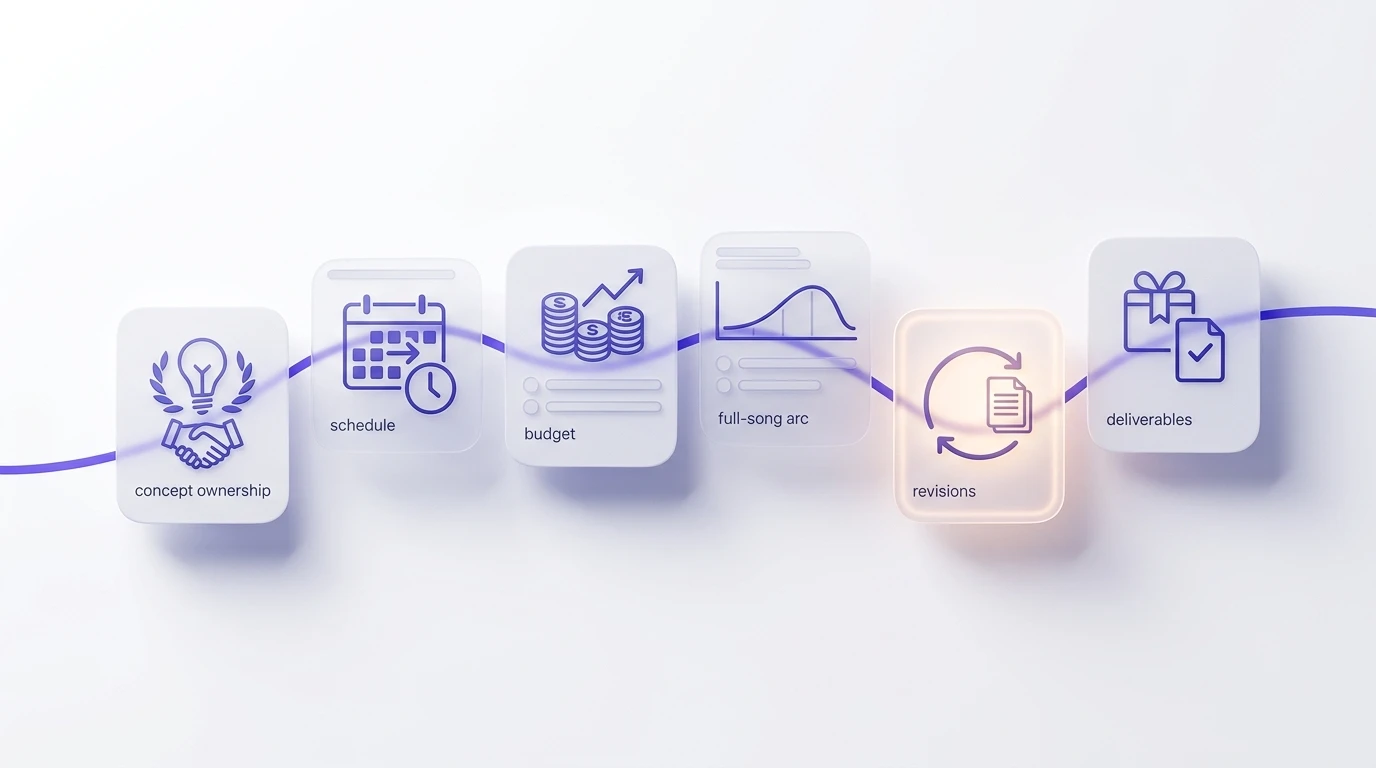
Use this scorecard for every proposal. Mark a criterion Pass when the evidence is written into the proposal, Verify when it remains a verbal promise, or Fail when the required work is excluded. An unresolved failure on cost, deadline, or deliverables should stop the booking.
| Criterion | Evidence needed for a Pass | Verify or Fail warning |
|---|---|---|
| Relevant portfolio work | Complete music videos attributable to your assigned director, with an approach suited to your track | Only commercials, highlight reels, or work by someone unavailable for your project |
| Director ownership | Named person responsible for the treatment and creative decisions through final edit | Direction passes between departments without a clear approval owner |
| Budget structure | Total price covering agreed pre-production, production, and post-production | Shoot price presented as the project price; editing or rentals remain open |
| Timeline | Start trigger, approval milestones, and final delivery date | “Fast turnaround” without a scheduled finish or client-feedback requirements |
| Revision policy | Written refinement allowance, feedback deadlines, and change-order rules | “Revisions included” without defining what can change |
| Final deliverables | Full-song master, agreed social versions, technical specifications, and file-rights terms | A teaser alone, unspecified exports, or unclear ownership |
Our guide to choosing a video production company expands the proposal-review process. For a music release, give complete-song evidence more weight than a broad commercial client list.
How do full-service firms, freelancers, and remote directors compare?
Full-service firms suit productions that need coordinated physical resources. Freelancers suit contained shoots with clear responsibilities. Remote directors using AI-assisted visuals suit concepts that can be built without capturing a live performance on location.
These are production models, not quality rankings. Judge the people and scope behind each proposal.
| Model | Best use | Budget structure to request | Main delivery risk |
|---|---|---|---|
| Full-service firm | Location-heavy concepts, studio filming, or productions requiring a coordinated crew | Complete quote covering preparation, crew, equipment, and post-production | A polished shoot proposal that leaves the edit or social adaptations undefined |
| Freelancer or small crew | A focused performance video or a contained narrative with limited production complexity | Agreed shooting scope plus an explicit post-production price | One person’s capacity becomes the schedule bottleneck |
| Human-directed, AI-assisted production | A cinematic visual world built around a finished song without relying on a physical shoot | Fixed creative and delivery scope, with refinement terms confirmed | Assuming generated scenes will remain consistent without active direction and editing |
A full-service proposal should connect location scouting to the treatment. Studio filming offers more control over lighting and access, but the quote still needs to identify equipment rental and any set work. For regional production contacts and location research, the Massachusetts Film Office is a useful starting point; permissions must still be confirmed with the relevant authority.
A freelancer can be the right choice for an intimate performance piece. Verify performance direction as carefully as camera work: the director needs a plan for expression, movement, and usable coverage across the song. If the same person edits, confirm their post-production availability before reserving the shoot.
SongTrailer uses human direction with AI-assisted visuals, with one creative director owning concept, pacing, and delivery from brief through final edit. Our AI music video offering for artists is a full-song option, not evidence of a Boston studio or an on-site filming crew.
SongTrailer’s flat package is $3,500, covering a full-song master and social-ratio adaptation. Our stated production window is about 5–7 business days after intake and direction lock. Confirm refinement terms and technical specifications before treating any package as a complete match.
Who should choose each production model?
Choose a full-service firm when the film depends on physical coordination. A choreographed performance with controlled lighting needs a different production setup from an abstract visual world built around a finished recording. Skip this model if the proposed crew and studio scope consume the budget you need for post-production.
Choose a freelancer when the idea is contained and the assigned person’s full-song work fits the track. A restrained performance film can benefit from close creative ownership. Skip this model if the proposal asks one person to manage a complex shoot and a release-critical edit without a credible capacity plan.
Choose a human-directed, AI-assisted model when mood and visual transformation carry the concept. It can suit an artist whose finished single needs a complete cinematic film without organizing a location shoot. Skip it when the essential requirement is documentary footage, precise choreography, or a faithful filmed performance.
For an EP, shortlist around the whole release schedule. Separate singles can share a visual language, but each film still needs its own pacing and delivery scope. Ask whether the proposed director can maintain continuity across releases without making every song look interchangeable.
How do you protect a fixed release date?
Protect the release date by scheduling backward from the approved upload-ready master. Leave a buffer for review and technical checks before the public release. A first cut delivered on launch day gives you no useful recovery time.
The critical distinction is booking date versus production start. A provider may begin its stated turnaround only after receiving the finished track and approving the direction. Changing the song version or treatment afterward can invalidate that schedule.
Pre-production should resolve the treatment and practical constraints before expensive work starts. For a physical shoot, that means confirming locations and crew availability. For AI-assisted production, it means locking the visual world and identifying continuity problems that could affect the edit.
Use the music videography workflow from treatment to final master to check whether a proposal covers the handoffs between planning and delivery. Name one client-side approver, and send consolidated feedback at each agreed review point.
Ask for calendar dates, not just a duration. The proposal should explain what happens if location access fails, the artist delays feedback, or the concept changes after approval. A deadline is credible only when its dependencies are visible.
Which exclusions or contract terms create delivery risk?
The largest delivery risk is a proposal that prices filming while leaving the finished video undefined. Quote the release asset, not just the shoot.
Crew rates belong inside a usable production estimate. Confirm expected working hours, overtime rules, and whether equipment is included. A day rate cannot reveal the final cost when preparation and post-production are billed separately.
Editing must have its own scope. Ask whether the price includes color grading, meaning the final matching and shaping of the image’s look. Identify planned visual effects explicitly: removing an unwanted object and building a complex transformation are different workloads.
“Vertical included” also needs definition. An alternate crop may cut off the artist’s face or remove essential action. Require the provider to explain whether the social version is a reframed full-song edit or a shorter cut, and check the intended upload against YouTube’s recommended encoding settings.
Refinement terms should distinguish changes within the approved treatment from new creative work. Define when feedback is due and what happens if you request a new concept after production starts. Do not assume that “unlimited revisions” includes reshoots or replacement scenes.
Licensing requires equal attention. The U.S. Copyright Office’s music guidance distinguishes the musical composition from the sound recording; confirm that you have the necessary permissions for the track used in the video. The contract should also identify responsibility for footage licenses and appearance releases where applicable.
For AI-assisted visuals, separate permission to use the delivered video from claims of exclusive copyright in every generated element. The U.S. Copyright Office’s AI guidance explains why human authorship matters to copyright protection. Ask what rights the provider can actually grant, and seek legal advice where exclusivity is essential.
Finally, distinguish master ownership from source-file delivery. An exported master is the finished playable video. Raw footage and editable project files are separate assets; the contract should say whether they are included and whether licensed materials can transfer with them.
Frequently Asked Questions
How much should a three-minute music video cost? Runtime alone cannot establish a useful price. Request a complete quote based on the concept, production requirements, and final delivery scope rather than comparing shoot rates.
Do I need a Boston-based company to make a music video? You need local production capability when the concept requires filming in Boston. A remotely directed visual production can be suitable when the film does not depend on physical location access or a live performance shoot.
Should a music video quote include editing and color grading? Yes, if you are purchasing a finished release asset. Any excluded post-production work should be identified before booking, with its cost and scheduling responsibility made clear.
Does owning the final music video include the source files? Not automatically. The agreement should distinguish rights to the delivered master from access to raw footage, editable projects, and licensed assets.
Shortlist the model that serves the song, then make each provider answer the same scope questions. If a human-directed, AI-assisted full-song film fits your release, get in touch with SongTrailer with your finished track and target date. Request a proposal you can compare by what will actually be delivered.