For artists searching “video production company chicago,” choose a partner with full-song work, a named director, and written delivery commitments. Chicago’s Film Office manages permits for filming on city property. A polished reel proves neither production readiness nor release-day delivery. Use the scorecard below to compare teams before booking calls or paying a deposit.
- Watch complete music videos before shortlisting a director. A reel can hide weak pacing and unresolved endings.
- Score providers on documented evidence. An impressive portfolio cannot compensate for an unconfirmed delivery date.
- Require a total production scope that identifies exclusions, revision rounds, and final-file specifications before paying a deposit.
- Choose a production model around the footage your concept requires. Live performance, cinematic storytelling, and AI-assisted visual worlds need different proof.
Which criteria matter when searching “video production company chicago”?
The right music video partner can explain how the treatment becomes an approved master. Creative taste matters. So does the person responsible when a scene fails, an edit stalls, or a vertical adaptation cuts the artist out of frame.
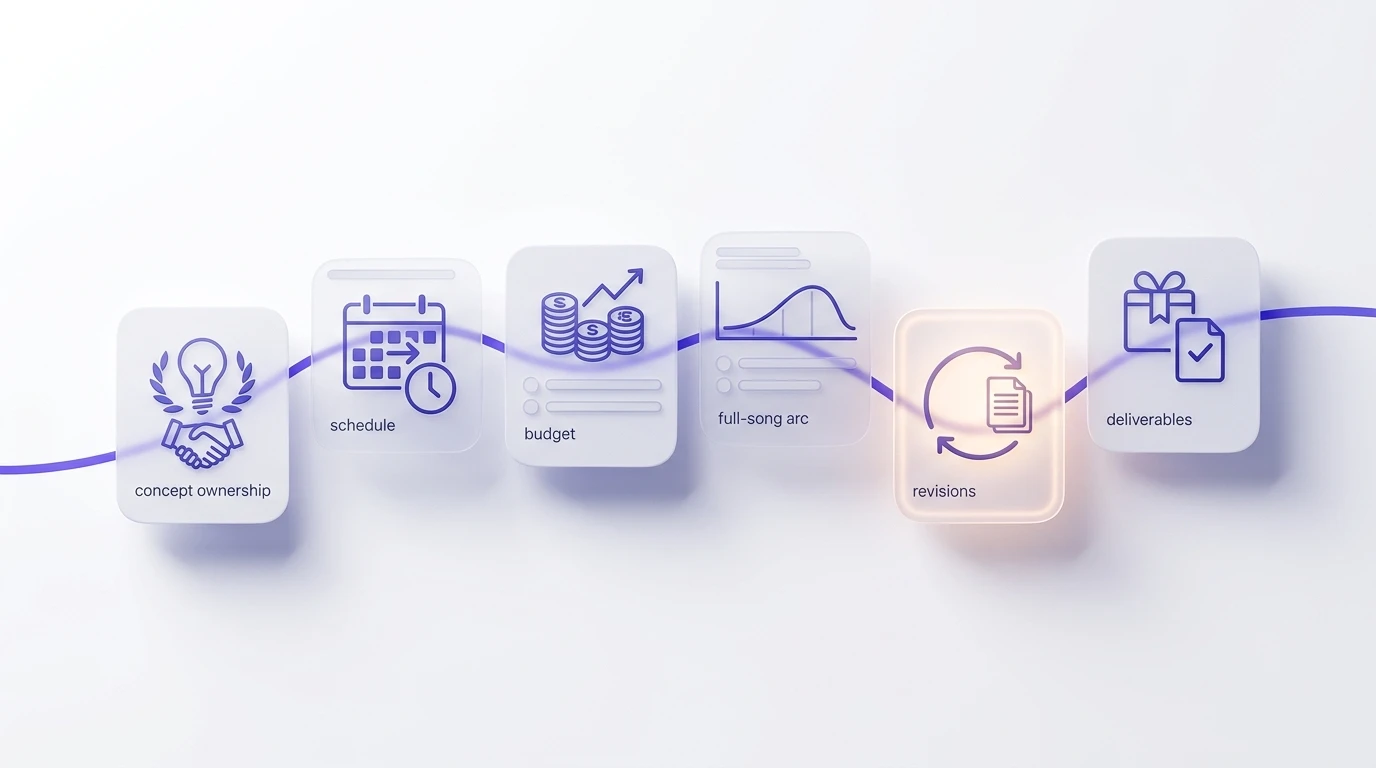
Use this scorecard for each shortlisted provider. Mark a criterion Pass only when you have supporting evidence; use Unclear for an unanswered question and Fail for a commitment that contradicts your campaign needs.
| Criterion | Evidence required for a pass | What should trigger clarification or rejection? |
|---|---|---|
| Creative ownership | A named director responsible for the treatment and final creative decisions | Sales promises access to a director who has not reviewed the brief |
| Relevant music work | Complete videos showing sustained pacing and a coherent visual world | Only reels, unrelated commercials, or short social clips |
| Budget transparency | A written total with inclusions, exclusions, and change-order terms | Crew, locations, or post-production remain unpriced |
| Schedule reliability | Approval milestones, artist-response deadlines, and a delivery commitment | A turnaround promise with no stated start condition |
| Delivery scope | Master specifications, social adaptations, revision limits, and rights terms | “Final video included” without defining files or permitted uses |
An unresolved schedule or delivery requirement should block the deposit. Use our guide to choosing a video production company to shape the evidence request, then send the same brief to every candidate. Comparable answers require comparable inputs.
For the director reel, choose a sequence you like and request its complete video. Watch the opening, then continue through the final frame. Does the visual language develop with the song, or does the edit exhaust its strongest material early?
Ask what the candidate actually directed. A company may show work involving outside directors, editors, or cinematographers; confirm who would handle your release and which portfolio pieces demonstrate that person’s contribution.
How should local, boutique, and AI-assisted teams be compared?
Compare production models by the work your concept demands. Local describes geography. Boutique describes team size, while AI-assisted describes a workflow; a Chicago boutique can operate across all of these categories.
The table shows where to investigate each model. These are buying considerations, not universal quality ratings.
| Production model | Strongest fit | Evidence to request | Main exposure to examine |
|---|---|---|---|
| Local live-action company | Artist performance, real locations, physical choreography | Complete performance videos, crew estimate, location plan | Shoot logistics, permits, studio charges, weather contingencies |
| Director-led boutique | A distinctive treatment requiring close creative control | Named director’s complete work and post-production plan | Limited capacity or reliance on unavailable collaborators |
| Human-directed, AI-assisted team | A cinematic visual world built around a finished track | Full-song examples, continuity tests, human-edit responsibility | Inconsistent faces, unstable movement, unclear asset rights |
A strong treatment explains how the song develops visually. Mood references alone cannot show whether the bridge needs a change of setting or whether a recurring image will still hold attention near the ending.
Ask the provider to connect the treatment to production decisions. Our music videography workflow from treatment to final master explains those handoffs; the proposal should identify who approves the concept and when the edit becomes ready for refinement.
For AI-assisted work, request proof of the difficult shots before approving the direction. Character continuity deserves particular scrutiny. A striking still frame says little about whether the same face and costume remain coherent across moving scenes.
Who is each production model best suited to?
Choose a local live-action team when the artist’s physical performance carries the video. Real choreography, recognizable Chicago locations, and interactions with other performers require a plan for capture. Skip a shoot-heavy proposal if its location costs consume money needed to finish the edit.
Choose a director-led boutique when the treatment depends on a specific creative voice. Confirm that the director you admire will stay involved through post-production. Skip the team if its availability depends on collaborators who have not committed to your dates.
Choose a human-directed, AI-assisted team when atmosphere and an invented visual world suit the track. Ask for tests if the concept requires recognizable likenesses or exact lip-sync. Skip this route when the brief depends on documentary footage of the artist at a real event.
SongTrailer’s AI-assisted music video package for artists costs $3,500 flat, with a full-song master and social-ratio adaptation delivered in about 5-7 business days after intake and direction lock. One creative director owns the concept through final delivery, combining AI-assisted visuals with a human edit. That start condition matters: an unfinished brief does not begin the production window.
For an EP campaign, check whether the provider can carry a visual identity across releases without recycling the same edit. Ask which elements remain consistent and where each song gets its own direction.
Which contract and delivery gaps should stop the project?
Stop when the proposal leaves a material cost, approval responsibility, or delivery obligation undefined. A deposit should secure an agreed scope. It should not expose the artist to expenses that appear after the treatment is approved.
A live-action estimate should identify crew charges and location expenses. If the concept needs a video production studio, confirm whether the quote includes the required equipment and any overtime exposure. Ask how cancelled shoot days or reshoots are handled.
Post-production needs its own boundaries. Confirm whether editing and color grading are included, what counts as a revision round, and who consolidates feedback from the artist and label. A new concept after direction lock may require a scope change; the contract should explain how that change is priced and approved.
File delivery and copyright ownership are separate contract questions. Specify ownership or licensing terms, including any third-party restrictions. The U.S. Copyright Office’s work-made-for-hire guidance explains why commissioning work alone does not establish work-made-for-hire status.
AI-assisted projects need additional clarity about generated material and artist likenesses. The U.S. Copyright Office’s AI copyright guidance distinguishes protectable human authorship from purely AI-generated content. A contract cannot guarantee exclusive copyright protection over every generated element.
Reject a vague promise of “all files.” Define the approved exports and separately state whether source projects or unused material are included. Ownership of delivered masters does not automatically answer every source-file question.
How should the schedule protect the release date?
Build the production schedule backward from the upload deadline. The public release date leaves too little room for discovering a broken export, missing approval, or unsuitable social crop.
Ask for milestones covering direction lock through final delivery. Each approval needs an owner and a response deadline; a label review that arrives late can move the finish even when the production team stays on schedule.
Leave a release buffer that allows an actual export check and any required correction. Its size should reflect the campaign’s approval process and distribution requirements. Do not accept a provider’s production turnaround as the complete campaign timeline.
Final-file specifications belong in the agreement. YouTube’s recommended upload settings identify 16:9 as the standard desktop aspect ratio, while its player adapts to other ratios. Specify the intended master rather than assuming “YouTube-ready” describes an export.
Treat vertical delivery as a separate editorial check. Automatic cropping can lose a second performer or remove a reveal that gives the shot meaning. Request the adapted export for approval, then inspect framing and titles on a phone.
Watch the full approved master outside the editing software before release. Confirm that it uses the correct track version, preserves sync, and reaches the intended ending. A timeline screenshot cannot prove that the delivered file plays correctly.
Frequently Asked Questions
What is the difference between videography and video production? Videography usually centers on capturing footage. Video production can include concept development, shoot planning, and post-production through final delivery, although providers use these labels differently.
How much does music video production typically cost in Chicago? There is no dependable citywide price without a defined scope. Request an itemized total that accounts for the shoot and post-production, including exclusions that could increase the final cost.
Does a music video production company need to be based in Chicago? Local presence is useful when the concept requires Chicago locations or an on-site artist performance. For a project built without a local shoot, evaluate creative ownership and delivery accountability more heavily than the office address.
What should I send a production company before requesting a quote? Send the finished track and intended release date, with visual references that explain what you like about them. State your budget ceiling and required delivery formats so the provider can quote the actual campaign.
Send each shortlisted team the same brief and compare its written commitments against the scorecard. For a finished single that suits a human-directed, AI-assisted visual approach, get in touch with SongTrailer with your track and release requirements. Choose the partner whose evidence supports the campaign you are ready to release.