
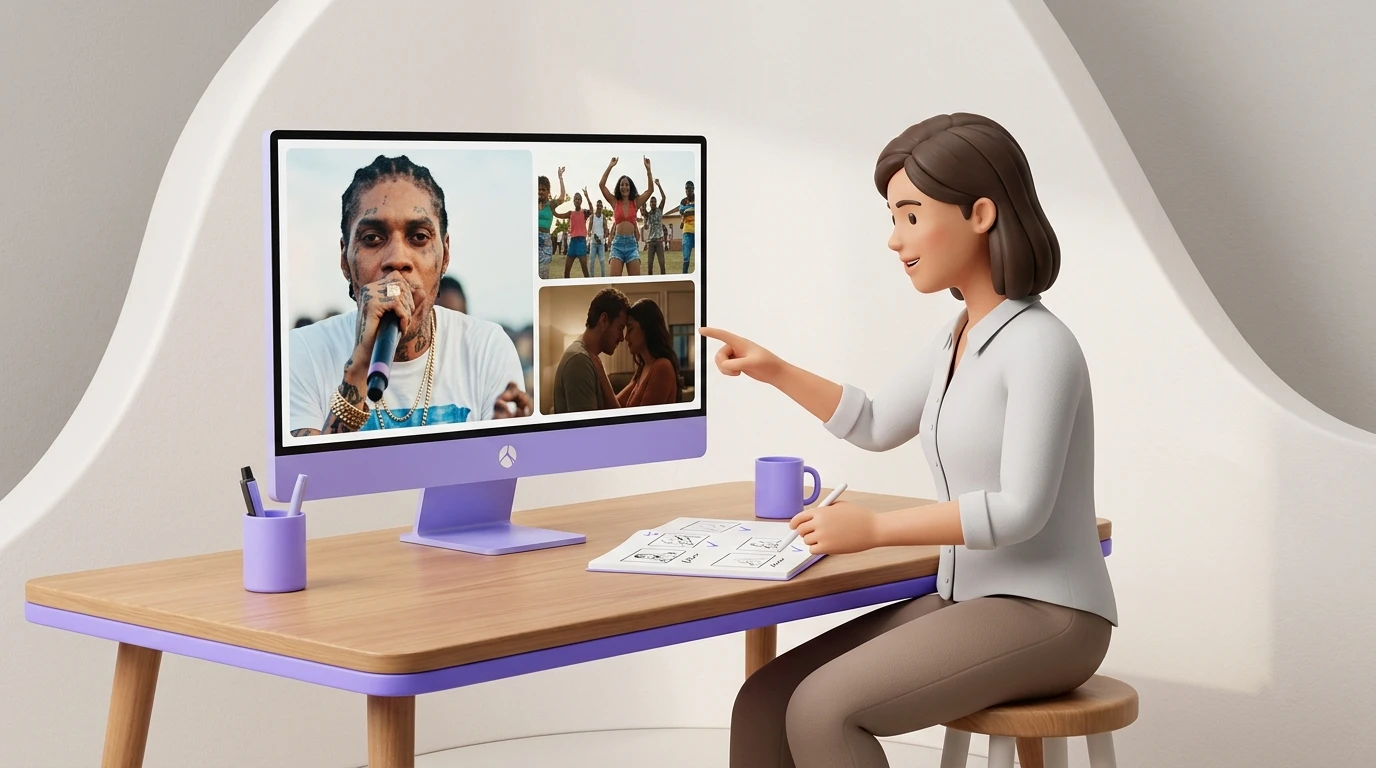
The catalog of vybz kartel music videos combines dancehall performance with imagery ranging from communal celebration to intimate or darker moods. YouTube labels “Don't Mess Up” an official visualizer, a useful reminder to check each upload's format. This guide maps the recurring visual language and explains how to read the release context.
- Check the format before comparing videos. An official music video, visualizer, and audio upload serve different purposes.
- Read dancers and locations as part of the song's performance. Watch how movement responds to vocal accents and changes in the rhythm.
- Separate the upload date from the filming date. A newly published video can contain archival footage.
- Record director credits and full-song changes when studying a reference. Borrow the visual principle, then build an original treatment.
What defines the visual style of vybz kartel music videos?
There is no single Kartel look. The recurring connection is between the song's attitude and the social world built around it: who occupies the frame, how they move, and what the setting communicates.
Party-oriented material makes communal energy a useful organizing principle. Romantic tracks invite closer attention to bodies and relationships. More confrontational material can use isolation, harder lighting, or symbolic objects to give the vocal a different weight. These are reading tools, not rules that every release follows.
A song such as “Summertime” is a useful starting point for considering how leisure and collective movement can carry a video without an elaborate plot. When watching romantic material such as “Fever,” pay attention to how framing establishes attraction and who receives the camera's attention.
Use this viewing sheet to make the analysis concrete:
| Visual element | What to record | What it can communicate |
|---|---|---|
| Performance framing | Direct address, close-ups, group frames, or performers seen at a distance | Authority, intimacy, or collective energy |
| Dancers | Individual gestures, shared routines, and interaction with the camera | A physical response to the vocal and rhythm |
| Fashion | Clothing changes, jewelry, styling, and recurring accessories | Status, self-presentation, or character |
| Location imagery | Domestic spaces, streets, leisure settings, or constructed environments | The social world surrounding the song |
| Color and light | Warm daylight, saturated interiors, darkness, or sharp contrast | Mood and changes between sections |
| Symbolic props | Objects that receive repeated attention | Desire, power, memory, or another story cue |
| Editing | Cuts on vocal accents, held shots, and repeated images | Momentum, emphasis, or deliberate restraint |
An object becomes a meaningful motif through its treatment. A vehicle in the background may simply establish a location. Repeated close-ups, interaction with a performer, or a return at a crucial lyric give it a stronger narrative role.
How do dancehall performance and street narrative interact?
Dancehall performance gives movement and vocal delivery substantial storytelling power. A video can establish relationships through a look, a gesture, or a group response before it introduces any conventional plot.
Britannica's account of dancehall music places the genre within Jamaican popular music and its relationship to reggae. That cultural grounding matters. Dancers, fashion, and neighborhood imagery deserve more attention than a generic reading of “party visuals.”
Watch who controls the space. A performer facing the lens creates direct address. A group responding around that performer establishes social recognition. A dancer carrying a sequence can shift attention toward the rhythm itself, especially when movement answers a vocal phrase rather than following a continuous routine.
Street narrative can be equally economical. A doorway, an exchange between characters, or a change in who enters the frame can imply belonging or conflict without dialogue. Avoid treating every street location as evidence of autobiography. A location is part of a production, and its meaning depends on the actions staged there.
For visual creatives, the useful lesson is give background performers a clear function. If everyone simply stands behind the lead, the scene offers little development. Reactions and changes in attention can make the same location feel alive across an entire song.
How has the visual presentation changed across release periods?
Read the catalog as overlapping production approaches. Performance-led videos coexist with releases that place more weight on other performers, narrative scenes, or graphics. A later upload does not automatically represent a newer filming style.
Legal context matters only when it helps explain production circumstances. The Privy Council's judgment in Palmer and others v The King records Kartel's 2014 conviction and quashed it in March 2024. His incarceration is relevant to understanding why a release from that period might use other performers or existing images instead of a newly filmed appearance.
That context does not establish the provenance of an individual shot. Treat footage as archival only when credits, documentation, or an identifiable earlier source support that conclusion.
Recent uploads also show why chronology and format need separate columns. The following titles, upload years, and format labels appear on YouTube; those publication years do not establish filming dates.
| Title | YouTube upload year | Format identified in the upload title |
|---|---|---|
| “Anything You Want Girl” | 2023 | Official music video |
| “Terror by Night” | 2023 | Official music video |
| “You Walked Away” | 2025 | Official music video |
| “Upside Down” | 2025 | Official video |
| “Don't Mess Up” | 2026 | Official visualizer |
Keep separate dates for the song release, filming, and video upload. If a description supplies only the upload date, leave the other fields unconfirmed. Reuploads and later promotional campaigns can otherwise make a catalog appear to develop in an order it never followed.
What should viewers know about official, featured, and post-release visuals?
An official release has authorization from the artist or relevant rights holder. The words “official video” in an upload title are a claim to check, not sufficient proof on their own.
Start with the uploader and description. YouTube's explanation of Official Artist Channels describes how the platform brings an artist's music and videos together. A label or authorized collaborator can also publish a legitimate release, so an upload outside the artist's own channel is not automatically unofficial.
For a collaboration, distinguish the lead artist from the featured performer. Kartel's vocal credit does not establish that he appears on camera. Check the performer credits and the actual footage before describing a video as a Kartel-led performance.
Format needs the same care. An animated music video can develop scenes and characters across the song. A visualizer may sustain a smaller set of images or loops. A lyric video puts readable words at the center, while official audio may use a static cover. Animation alone does not determine which category applies.
A post-release visual is simply a visual published after the track. It might be a newly commissioned film, an alternate edit, or an archival presentation. The publication sequence does not tell you which.
Director credits are worth recording alongside the uploader. Look for separate directing and editing credits in the description, then check any linked production portfolio. Missing credits should remain marked as missing. Do not assign authorship because another video has a similar color grade.
How should creatives study full-song pacing?
Study a complete video before extracting a striking shot. Full-song pacing is the distribution of visual changes across the track, including the moments when the editor deliberately holds an image.
Make a simple viewing log. Record the song section, the main image, and what changes when the section returns. A chorus might introduce a wider group frame; a later chorus might repeat that setup with a different performer or stronger lighting. If nothing changes, ask whether repetition reinforces the hook or simply exhausts the available footage.
Then watch a social excerpt. A crop can remove the dancer who balances the composition, while a short edit can omit the scene that explains a prop. Social circulation gives individual moments a second life, but those moments can lose the meaning they have in the full-song master.
For your own release, turn the observation into a treatment instruction: “Hold the first verse in one location. Introduce group movement at the chorus. Change the lighting when the hook returns.” This is an original planning example, not a description of a specific Kartel video.
Our guide to music videography from treatment to final master explains the production path behind those decisions. Lock the visual world before building shots, especially when continuity across scenes is already a concern.
At SongTrailer, one creative director owns the concept and pacing through final delivery, combining human direction with AI-assisted visuals. Our AI music video approach for artists serves finished tracks that need full-song treatment. SongTrailer's flat package is $3,500, with a full-song master and social-ratio adaptation delivered in about 5-7 business days after intake and direction lock.
When a release date is close, confirm what starts the production clock and which formats are included. The questions in our guide to choosing a video production company help separate a workable delivery plan from an attractive reference reel.
Frequently Asked Questions
Where can I watch Vybz Kartel music videos for free? Many official uploads are available to watch on YouTube without a paid subscription, although regional restrictions can apply. Check the artist, label, or authorized collaborator's channel and distinguish full videos from audio uploads.
Is there a complete official playlist of Vybz Kartel videos? Do not assume a playlist is complete or official because its title says “all music videos.” Check its owner and inspect the entries, since fan playlists may combine authorized releases with mixes, duplicate uploads, and unofficial edits.
Why does Vybz Kartel not appear in some videos featuring his music? A vocal performance and an on-camera appearance are separate contributions. A release can use dancers, actors, animation, or archival material; production credits and documented release context are needed to explain a particular video's choices.
Can I use footage from these videos in my own release? Public availability does not give you permission to reuse footage. The U.S. Copyright Office's explanation of protected works includes music and audiovisual works; obtain the necessary permissions unless a valid legal exception applies in your jurisdiction.
Choose a verified upload and watch how its images develop across the complete track. For your own finished single, translate those observations into an original visual world. Get in touch with SongTrailer with your track and intended release date to discuss a full-song video.